

Mock court cases give MDX students the first chance of being a lawyer and social worker
15 December 2025
/7x0:1033x697/prod01/channel_3/media/middlesex-university/news-section-images/Moot-Court-1.jpg)
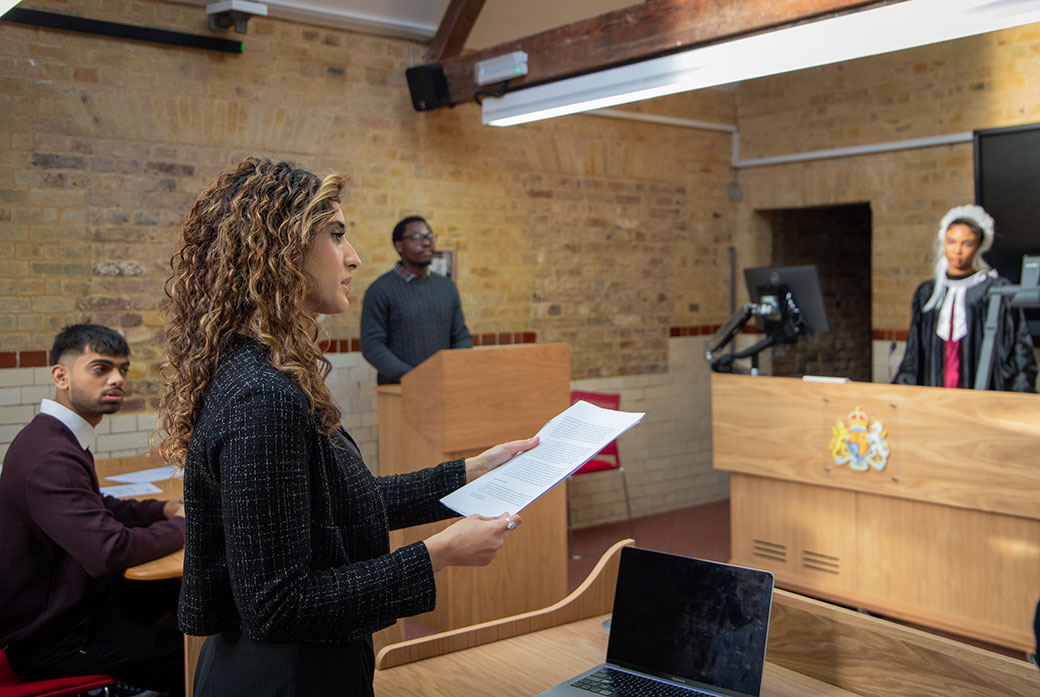
Hundreds of students across Middlesex University’s campuses have been taking part in mock appeals and cases based on real life hearings
More than 500 law students across Middlesex University’s three campuses have been taking part in mock criminal court appeals in the past fortnight.
LLB Law students in London, Dubai and Mauritius have been presenting their legal arguments in ‘moot appeals’ which are based on real life court hearings and cases.
Year one and two students take part in these moots, which are worth 40% of their overall mark. In the first year it is part of their Legal Skills module, while in the second year it is based around EU law.
For many first-year students it is their first experience of being an actual lawyer as the moot appeals are modelled on the strict procedures and etiquettes of courtrooms.
Both babies subsequently died and the doctor made this initial decision without informing staff or the child’s parents. The doctor was convicted but is now appealing the case in the Court of Appeal on the grounds that the conviction is unsafe.
Students have been researching similar court cases and the verdicts, which are known as ‘precedents’. In groups of four and 45-minute sessions, the students will present their arguments for and against the convictions to academics this week who are acting as judges.
“The moot appeal involves far more than just presentation in court, the students complete their own research in order to really understand the precedents,” said Joseph Corkin, a Senior Lecturer in Law at Middlesex University and a qualified barrister who will be hearing the moot appeals.
“Students put together a ‘skeleton argument’ which is a summary of the case they are going to use and present the arguments under-fire with questions from academics so they must think on their feet like a real lawyer.
“The students really enjoy the competitiveness of it as they taking on another group of lawyers and pitting their wits against them. They will make mistakes but that is part of the learning process."
“For the first time in their law degree, many students feel that they are on their journey to becoming a lawyer. Some of them also decide there and then that they would like to become barristers which is a type of lawyer focused more on litigation.”
At the end of their three-year LLB Law course students will decide whether to become a barrister, who present legal arguments in court, or a solicitor who are focused on legal preparation and client management.
For third-year student Danyal Nauroz, the moot appeals helped him decide which path to follow: “I found that I enjoyed the research part more than the presenting because I feel it is my strong point. It helped me reflect on my best skills.
“I’m wanting to become a solicitor because it is so interesting doing the field work.”
Waleed Naqvi, a first year LLB Law student, has been relishing the moot appeals and revealed that he had been studying up to 15 similar precedents.
“I’m really excited by the moot appeals because this is my first experience of being a lawyer,” said Waleed.
“I’m a bit nervous, excited and curious at the same time, but it’s going to be a great experience. I really want to become a barrister, and this is a great opportunity for me to test myself to the best of my abilities and it will surely help me in the future.”
As part of their studies Year two students on the BA Social Work Programmes have also taken part in court role plays in Hendon Town Hall council chambers, next to Middlesex University’s campus in London.
Students developed courtroom skills for specialist court and tribunal hearings, including Family Court, Court of Protection, Mental Health Tribunals and Youth Court.
In one mock case a person was detained under the Mental Health Act, and decisions were made about safeguarding a persons' best interests and deprivation of their liberty, as well as recommendations about who should care for children who could no longer live with their parents. There was also a scenario involving a young person on the edge of care who had been arrested for drug possession and carrying a weapon having been coerced and exploited.
Cynthia Lane-Hand, Programme Leader for BA (Hons) Social Work, said: “As well as learning about legal frameworks, this was a great opportunity to practice as a social worker in court before the real thing and learn from experts. Above all we want students to feel more confident in court settings so that their social work role and responsibility for safeguarding and achieving best outcomes for vulnerable children and adults is represented well when they qualify and it becomes very real. We think that the students demonstrated that they are well on their way to achieving this."
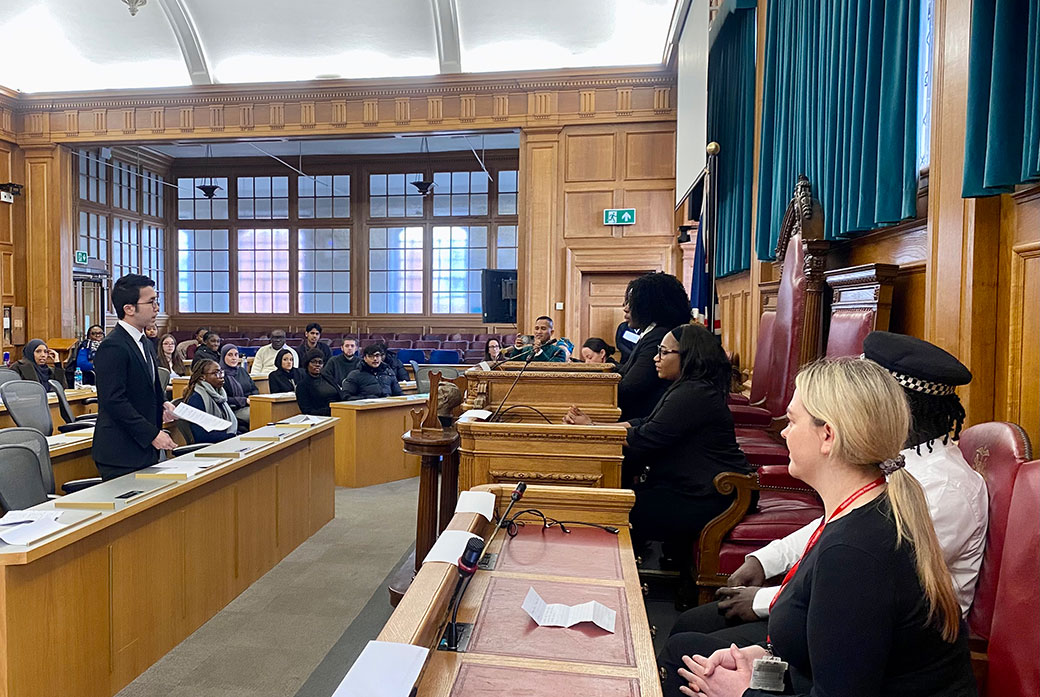
One student Evelyn Ajegbe said: “The Mental Health Tribunal role-play was a memorable moment in my learning journey. Stepping into the role of the Senior Nurse helped me understand what it feels like to speak up for someone’s rights when they are at their most vulnerable. I was nervous at first, but working closely with my group and taking part in a multi-disciplinary decision-making process gave me the confidence to express myself clearly in a realistic courtroom setting.
“This experience showed me how communication, teamwork and shared professional responsibility can support better outcomes for individuals. It has helped me feel proud of how far I have come and excited for the social worker I am becoming.”
Another student Sayeda Jahan said: "Taking part in the Youth Court role play at the Town Hall Chamber in Hendon was an exciting and memorable learning experience for me. Our group worked collaboratively to research the Youth Justice System and prepare for our roles, including magistrates, legal representatives, police, social worker and the young offender.
"Presenting the scenario in such a formal setting felt both thrilling and rewarding, and it gave me a realistic insight into courtroom processes and decision-making, especially when the young person received a referral order. This was my first time in a council chamber, and the whole experience was inspiring, educational, and truly motivating for my Social Work career."
Middlesex University would like to thank Barnet Council for allowing use of the facilities and Czar Tan Youth Justice Service Manager and team members, Katrina McKane, Enablement Team Manager at Barnet, Enfield and Haringey NHS Trust and Afiya Rufaro, the Deputy Head of Social Work and Social Care at the Central and North West London NHS Foundation Trust and North West London NHS Foundation Trust, who mentored the students. Clair Marie-Dwyer, a practitioner and part-time academic at MDX teaching Social Work Law who trains Social Workers across London, was hugely helpful in bringing experts together.
Find out more about studying Law and Social Work at Middlesex University.
/8x0:1033x697/prod01/channel_3/media/middlesex-university/news-section-images/2026/Drug-education-Porgamme2.jpg)
/8x0:1033x697/prod01/channel_3/media/middlesex-university/news-section-images/2026/Enactus-MDX-team-photo.jpg)
/8x0:1033x697/prod01/channel_3/media/middlesex-university/news-section-images/2026/Spring_grad_2026_highres-26.jpg)