

Powerful new documentary highlights domestic violence crisis in the Philippines
9 December 2025
/7x0:1033x697/prod01/channel_3/media/middlesex-university/news-section-images/2025/Domestic-Violence-2.jpg)
MDX academic Erminia Colucci’s new film reveals stories of family and domestic violence and its impact on mental health
The content below includes descriptions of domestic abuse, which some readers may find distressing.
As the world marks Human Rights Day on December 10, a powerful new documentary called ‘Chocolate and Roses: Breaking the Silence on Domestic Violence in the Philippines’ has been released. Based on visual research by Middlesex University academic Professor Erminia Colucci, the film highlights harrowing stories of domestic and family violence against women and girls in the Philippines and its impact on suicidal behaviour on those who experience it and children who are witnesses.
The film covers distressing accounts of domestic abuse including a woman in Cebu City who sleeps in a truck every night with her children but plans to return to her abusive husband as he is the bread winner and another woman called Maria in Metro Manilla whose husband poured boiling hot milk on her and threatened her with a knife. She admits to having suicidal thoughts because of the abuse.
One woman Rose recalls her drug-addicted husband punching her in the stomach just after she had given birth. She fought back and overpowered him, but many others are trapped in abusive relationships subject to repeated violence. “This is Filipino culture, whatever your husband does, you have to tolerate him,” said Rose.
One women Nenita described how her abusive husband is a boxer who was attacking her before neighbours rescued her. She felt “ashamed” as she became a “topic in the office” because she regularly had cuts and bruises.
“It was painful to see how these women have been impacted and the cultural and structural barriers to break away from the abusive relationships but it was also a privilege to document the empowerment of those who were able to rebuild their lives. Most of them were in a relationship which they escaped but there are still scars as much as fifteen years later and not just physical but emotional and mental scars.”
Erminia Colucci, a Professor of Visual Psychology who was the director and lead investigator
Funded by a University of Melbourne award to Prof Colucci, the film was carried out in collaboration with Dr Dinah Nadera (Ateneo de Manila University, School of Medicine and Public Health), the National Center for Mental Health in the Philippines, and the Centre for Mental Health, Global and Cultural Mental Health Unit at the University of Melbourne.
The Philippine Embassy in Washington, D.C. has recently shown the film as part of the country’s 18-Day Campaign to End Violence Against Women (VAW).
Through deeply moving accounts, the documentary shows how women from all walks of life are affected and how the stories cross social classes, gender identity and ethnicity, revealing domestic violence spares no one. The film also explores how legal and cultural frameworks compound the struggles.
Dr Judy Taguiwalo, University of the Philippines Center for Women and Gender Studies, explained how Spanish and US colonial rule led to patriarchy and maintained the Catholic church's power, creating a culture where women are viewed as “weak and under the control of men”.
“We're saying 'no that is not right, and no that should be stopped' because women are part of humanity,” said Dr Taguiwalo. “And their humanity should be respected should be protected and their potentials as people should be allowed to bloom and to prosper and violence prevents that from happening.”
Prof Colucci’s film reveals how the Philippines is the only country in the world (barring the Vatican City) without a divorce law, and while the Absolute Divorce Act is under consideration by the country’s Senate (upper house) after being approved by the Philippine House of Representatives (lower house), it has faced opposition which makes the release of the film even more timely.
Currently, according to Prof Colucci, in some rare circumstances couples can legally separate or annul but the process can take years and doesn’t consider domestic violence to be a reason for separation.
When discussing domestic violence laws, Senator Risa Hontiveros, from the Akbayan Partylist, said that some male legislators joke women “invited or deserved that kind of violence for nagging their husband or partner”. She added: “Despite the gains made by the women's movement in the Philippines in the past decades, we still have a long way to go.”
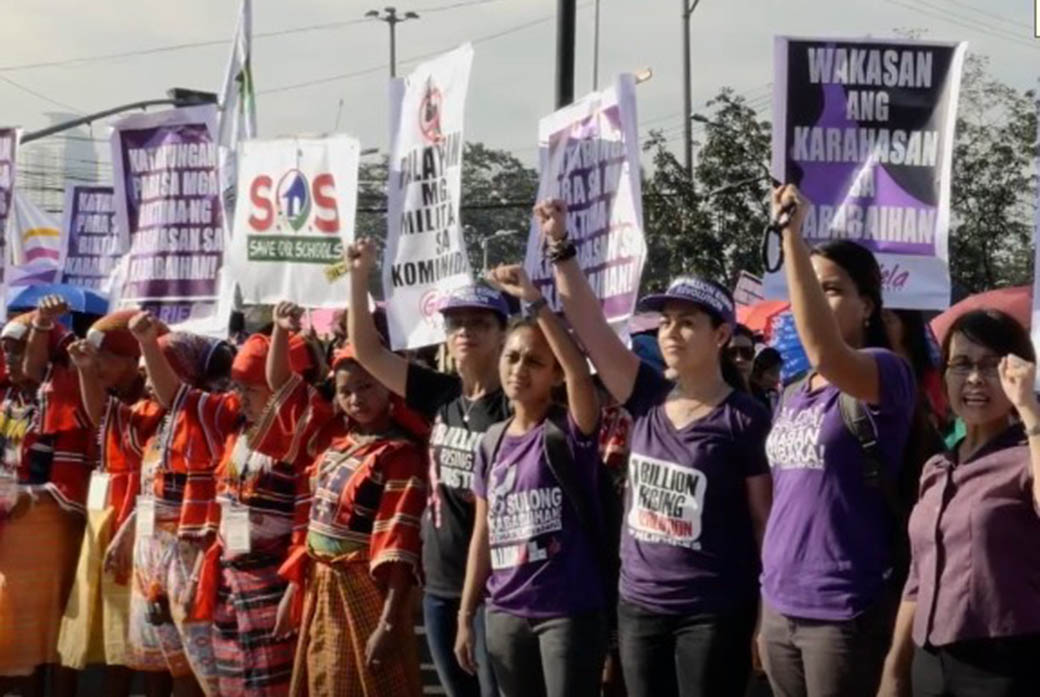
It is a sentiment echoed throughout the film which shows a growing women’s movement and various efforts to tackle domestic violence in the Philippines including the police unit dedicated to protecting women and children. Local government units known as the Barangay can remove abusive partners from home for fifteen days and a victim can apply for a permanent protection order through courts so the abuser never return to the house.
Attorney Dinah Myrtle Pacquing, however, explained in up to 90% of cases the victim is without an income or reliant on their partner and so they will eventually withdraw the case.
One woman who is a psychiatrist reveals how she managed to get annulled from her husband after years of abuse, but she felt a “kind of shame” given her profession. She said: “I don't want people to experience what I have gone through. The pain and the emotional effect was too hard, too traumatic. No woman is entitled to be abused. And I believe that my story would tell you ‘don't live with the pain. Get out of the relationship if there is abuse’.”
Prof Colucci said: “It was brave of her to use her story because we assume this only happens to people who are poor or uneducated. Sadly, anyone can be impacted and the place where abuse is most likely to happen is behind closed doors in their own home. For a woman the home should be a safe place but that is where most of the violence takes place, including physical, sexual, emotional, financial and psychological.”
Although focused on the Philippines, Prof Colucci says the film is a “universal call to acknowledge and challenge the violence endured by millions of women and children and the impact domestic violence has on the mental health and suicidal behaviour of all those involved ”.
Prof Colucci is asking for the support of government and nongovernment organisations, universities and charities to organise advocacy and educational screenings.
For more information contact Prof Colucci.
/8x0:1033x697/prod01/channel_3/media/middlesex-university/news-section-images/2026/MDX-Tax-and-Accounting-Clinic1.jpg)
/10x0:991x667/prod01/channel_3/media/middlesex-university/news-section-images/2026/2nd-year-students-with-Adaptive-Reuse-prototype1000X667.jpg)
/8x0:1033x697/prod01/channel_3/media/middlesex-university/news-section-images/2026/Drug-education-Porgamme2.jpg)