

/0x347:2200x1264/prod01/channel_3/media/middlesex-university/study-section-images/subjects/psychology-and-neuroscience/psychology-neuroscience-banner.jpg)
Psychology and Neuroscience Courses
Study psychology and neuroscience in London, where cutting-edge science meets human impact. Join a community driven by curiosity, compassion and discovery, and start building a future where your insight can change lives.
Why choose us?
Our psychology and neuroscience courses explore how the brain, mind and behaviour interact, from molecules and neurons through to individuals, groups and societies. You’ll examine topics such as brain function, cognition, emotion, mental health and human development while gaining the research skills to collect, analyse and interpret data.
Across our undergraduate psychology degrees, including our British Psychological Society (BPS)–accredited BSc Psychology, and our BSc Neuroscience, you’ll study core areas of psychology and neuroscience before choosing specialist options in areas like clinical, cognitive, social or biological psychology.
Postgraduate routes, including cognitive and clinical neuroscience and psychology conversion courses, let you deepen your expertise or change direction towards professional or research careers.
Many of our courses also offer a placement year or practice-based modules, so you can apply what you learn directly in clinical, educational, forensic or research settings and start building your professional network while you study.
rocket_launch Career-focused degrees
Accredited, career-focused degrees that blend scientific theory with practical experience and real clinical insight, giving you a strong foundation for professional and postgraduate pathways.
biotech Research active experts
Teaching from research-active experts at the forefront of cognitive psychology, neuropsychology and neuroscience, so you’re learning the latest thinking from people shaping the field.
workspaces Industry connections
Industry and NHS connections in London including Great Ormond Street Hospital, St George’s Hospital, the Priory and multiple NHS trusts, helping you build networks that accelerate your career.
apartment Advanced facilities
Access to advanced labs and facilities including bioanalytical labs, psychophysiology suites, VR labs and specialist neuroscience spaces where you’ll apply theory through real experiments.
Courses in psychology and neuroscience
/0x426:6048x3607/prod01/channel_3/media/middlesex-university/courses-images/ug-courses/science-and-technology/psychology/Psychology-099.jpg)
Facilities
Gain access to £36 million state-of-the-art facilities in our Hatchcroft building, with specialist spaces designed for professional-standard psychology and neuroscience teaching and research. You’ll learn in:
- Psychophysiology, auditory cognition and social observation labs
- Biological and cognitive psychology labs equipped for experiments with human participants
- A video editing suite for analysing behaviour and experiments
- Virtual reality labs for immersive research into perception, movement and rehabilitation
For neuroscience, you’ll also use our specialist facilities at StoneX Stadium, which include simulation suites, specialist labs and high-performance spaces where you can explore brain, muscle and physiological function in action.
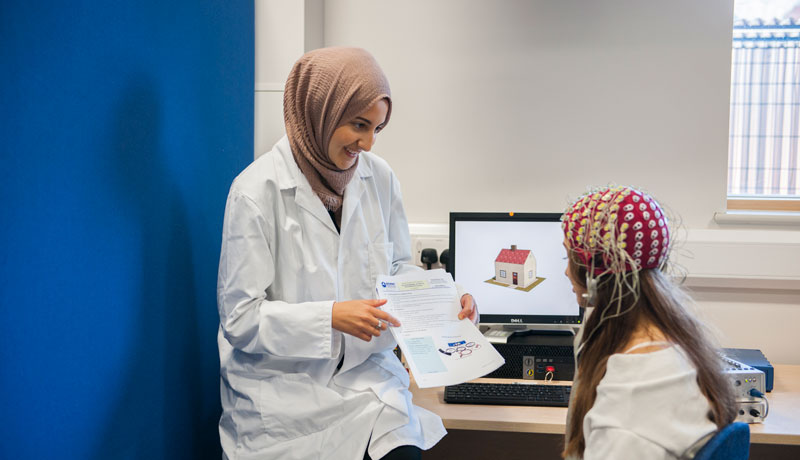
Our facilities support specialist procedures such as psychophysiological monitoring, electroencephalography (EEG) and brain imaging techniques, so you graduate confident using the tools of modern brain science.
/0x71:1000x597/prod01/channel_3/media/181---Students-around-campus.png)
Industry experience and partnerships
From the moment you start your psychology or neuroscience degree, you’ll be encouraged to connect your learning with real people and real organisations. We work with institutions such as:
- UCL Institute of Education
- Great Ormond Street Hospital School
- St George’s Hospital and the Priory
- The Institute of Psychiatry
- Metropolitan PoliceNHS trusts and other healthcare providers
Through placements, projects and research collaborations, our partnerships give you an insight into clinical practice, education, mental health services, forensic work and research environments.
Our Careers and Futures service will support you from your first term with CV workshops, application coaching and networking events. With 1000+ links with employers in London and globally, you’ll have expert guidance as your ambitions evolve, whether you’re applying for an assistant psychologist role, a research assistantship or a competitive MSc or doctorate.
“The labs and facilities are fantastic, from EEG to biofeedback. My placement as an Assistant Psychologist has been eye-opening and has given me real clinical experience I’d recommend to every student.”
Careers and employability
A psychology or neuroscience degree from Middlesex opens doors across health, education, business, research and the public sector. You’ll also develop in-demand skills in communication, data analysis, critical thinking, research design and understanding human behaviour, all highly valued by employers.
Graduates from our psychology degrees go into roles such as:
- Counsellor
- Assistant psychologist
- Social worker
- Teacher or learning support specialist
- Researcher or data analyst
You could also build a career in areas like human resources, marketing, user experience, business management, policy or clinical support roles.
If you are studying neuroscience, you might:
- Progress to postgraduate diplomas, MSc or PhD programmes
- Work towards roles in the NHS or private sector as a clinical scientist, healthcare scientist, physiotherapist, data analyst, nurse or medical doctor
- Move into research and development or academic research, often via fast-track training programmes for NHS professions
Our London location, industry links and dedicated employability support mean you’re well placed to secure relevant experience during your degree and take confident next steps into work or further training.
Entry requirements and how to apply
At Middlesex, we're proud of how we recognise the potential of future psychology and neuroscience students like you. We make fair and aspirational offers because we want you to aim high, and we’ll support you all the way.
General requirements for psychology and neuroscience courses
Undergraduate: 80-112 UCAS tariff points. A Level (or equivalent) in a science or social science subject preferred.
Postgraduate: A 2:2 honours undergraduate degree or higher in psychology, neuroscience, clinical neuroscience or a related degree.
Some courses may require existing work experience, please refer to each psychology and neuroscience course for specific entry requirements.

How to apply
Please refer to each psychology and neuroscience course for information on how to apply.
/140x0:921x693/prod01/channel_3/media/middlesex-university/study-section-images/subjects/psychology-and-neuroscience/Psychology-student-community.jpg)
Student experience and community
You’ll be joining a friendly, diverse and supportive community of students and staff who are passionate about understanding the mind and brain and improving people’s lives. Small-group teaching, research-active lecturers and dedicated pastoral support help you feel known as an individual, while student societies and research groups give you extra ways to get involved.
Take your next step
/14x0:1266x660/prod01/channel_3/media/middlesex-university/study-section-images/subjects/psychology-and-neuroscience/Psychology-open-day.jpg)
Book an open day
Join us on campus or online to hear what it's like to be part of our community of staff and students here at Middlesex University London.
/14x0:1266x660/prod01/channel_3/media/middlesex-university/study-section-images/subjects/psychology-and-neuroscience/Psychology-prospectus.jpg)
Request your prospectus
Take your first step to the future you want with our guide to Middlesex.
/0x225:2200x1385/prod01/channel_3/media/middlesex-university/clearing/students-on-campus.jpg)
Chat with students
Chat to our current course ambassadors and ask them any questions you have about studying at Middlesex.
/0x223:2210x1388/prod01/channel_3/media/middlesex-university/about-us-images/events/Reseach-conference-2025.jpg)
Get in touch
Have a question for us? Here you can find the relevant contact details for a member of our staff who can help you.