

An unforgettable evening in the company of Revd Jesse Jackson
18 February 2026
/0x78:602x487/prod01/channel_3/media/middlesex-university/mdx-voices-images/jesse-jackson-kurt-barling-laughing.jpg)
Article Written By
Kurt Barling, Deputy Dean for Research and Knowledge Exchange in the Arts and Creative Industries FacultyRevd Jesse Jackson was a giant of a man. He was not perfect, but he was authentic, sincere and honest. He believed in social justice and equity and carried the torch of change from the moment he saw his mentor Martin Luther King Jr gunned down in 1968. He built allyship into a political movement and ran for the Democratic Party nomination in the United States as their presidential candidate twice in 1984 and 1988. Although he didn't win, at the time he beat the likes of Al Gore and Joe Biden and look what happened to them when they tried again. He set the stage for President Barack Obama to be taken seriously when the moment for change presented itself.
And yet with all that he remained a man with humility. I interviewed Jackson several times for the BBC. He had the habit of joshing with TV interviewers to keep them on their toes. I admit I was wearing some Paul Smith socks for one interview (a present from Mrs Barling) and he remarked before the interview started that they were the kind of socks that President George Bush and a range of other people he regarded as having political leanings he disapproved of. I laughed it off but was piqued that he thought I could be so easily unsettled. I did my job without fear or favour. I did ask him what size feet he had, interview concluded. His communications adviser thought I was being rude!
As chance would have it, I was invited to a dinner being held by the Speaker of the House of Commons in Jackson’s honour in the former’s parliamentary residence. I gave a gift to Jackson on that evening with a message attached, “never judge a man by the colour of his…. socks”. He roared with laughter and put a pair of the Paul Smith socks straight on. You see he had a sense of humour too. He also admired chutzpah.
A visit to Middlesex University
Shortly afterwards the “sock-man”, as he then called me, asked him to come and share his experience, wise counsel and humour with staff and students at Middlesex University. It was perhaps one of the most memorable public events in the University's history. 90% of our students come from less privileged backgrounds. The event was 200% over-subscribed. We created a film to remember the event and students got to do their own interviews. People reacting like a popstar was in their midst such was his recognition and their respect for him. His message that everyone despite their humble beginnings can "be Somebody" and that it was through knowledge and learning through diversity we "keep hope alive" was a message that 13 years on continues to resonate in our profoundly diverse university environment.
In fact, we still have an artefact on our Faculty entrance wall which reminds students that "I Am Somebody". It was signed on the evening of the address to the University, and I can’t pass it without a sense of pride in that moment and what it achieved.
/43x0:613x400/prod01/channel_3/media/middlesex-university/mdx-voices-images/jesse-jackson-audience.jpg)
/33x0:623x414/prod01/channel_3/media/middlesex-university/mdx-voices-images/jesse-jackson-podium.jpg)
/37x0:620x409/prod01/channel_3/media/middlesex-university/mdx-voices-images/jesse-jackson-kurt-barling-podium.jpg)
/17x0:599x408/prod01/channel_3/media/middlesex-university/mdx-voices-images/jesse-jackson-board-1.jpg)
/72x0:585x360/prod01/channel_3/media/middlesex-university/mdx-voices-images/jesse-jackson-board-2.jpg)
/43x0:613x400/prod01/channel_3/media/middlesex-university/mdx-voices-images/jesse-jackson-plaque.jpg)
Grace and humility were the lessons I took from this man of substance. He trod where others feared to tread and he had the moral courage to admit his faults but to remind us that public service is a worthwhile vocation.
A lasting legacy
Jesse Jackson also valued the human connection. He stood with the people not above or apart from them. Perhaps that was one of the benefits of never having really held high office, he was able to retain a principled stand on many public issues, even if sometimes you didn’t agree with all those principles.
A year after his visit to Middlesex I lost one of my younger sisters, Kathleen (a Middlesex alumni) to breast cancer, aged just 47. Jesse got to hear about it from others, and he wrote me a letter which he asked I read out at her funeral. He never met my sister but he considered her part of his family of allies because of our connection. For a man who was mentored in the shadow of greatness, this gesture was a mark of his ultimate humility.
We will miss his like, but in many ways his strength was in his message and that will never be forgotten because he showed that equity, justice and respecting difference are values that we can remain proud to champion. Place humanity at the forefront of your ambitions and that will Keep Hope Alive.
About the writer
Kurt Barling is Deputy Dean for Research and Knowledge Exchange in the Faculty of Arts and Creative Industries.
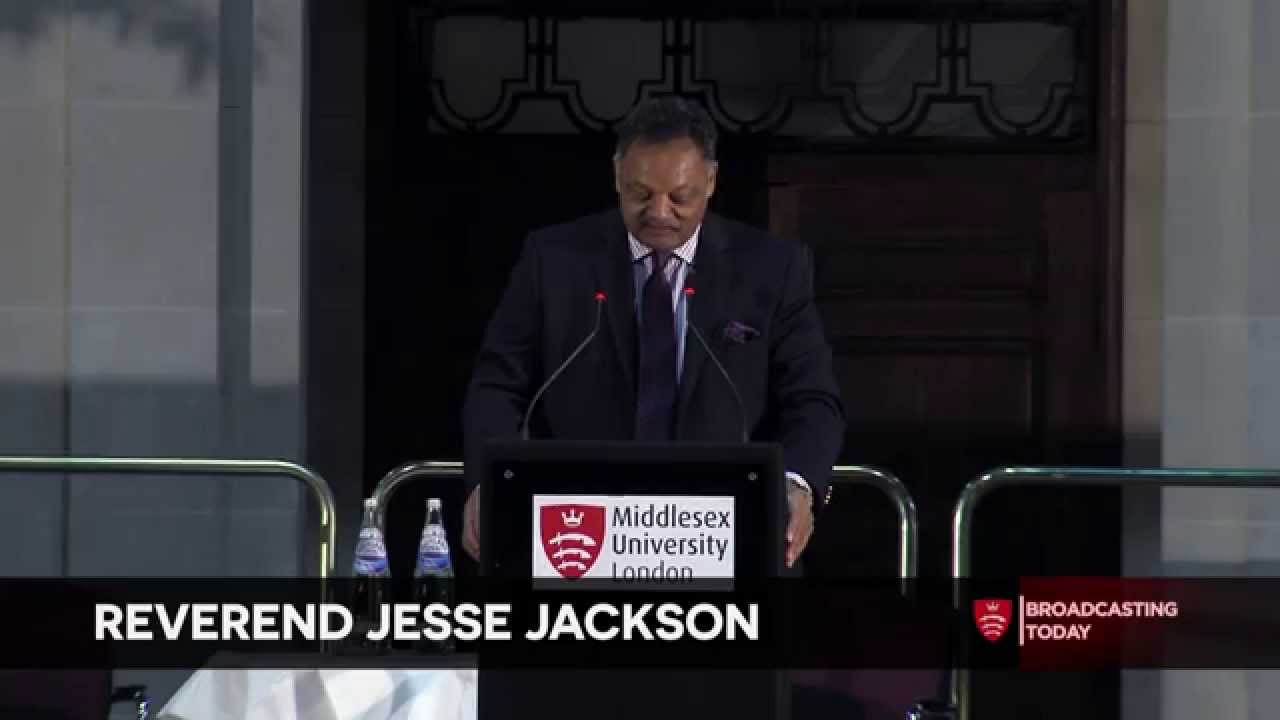
BROADCASTING TODAY REVEREND JESSE JACKSON SPECIAL REVEREND JESSE JACKSON ADDRESS TO MIDDLESEX UNIVERSITY LONDON 50TH ANNIVERSARY OF MARTIN LUTHER KING "I HAVE A DREAM" SPEECH 4TH DECEMBER 2013.
I'm delighted to welcome our students, staff, and friends of Middlesex University. It gives me great pleasure to welcome you all to hear the address from the Reverend Jesse Jackson. And on behalf of the of Middlesex University, may I say, Reverend Jackson, that you are most welcome. I'm delighted that you are here to address the students, staff, and friends of Middlesex University. Let me say something about my university. Middlesex University, I believe, is a working example of what you, Reverend Jackson, have been striving for throughout most of your life. There can be few, if any universities, that are as diverse in the international and ethnic backgrounds of its staff and students as here at Middlesex University. There are over 150 nationalities among our students, studying together in an inclusive and harmonious atmosphere. If you would beg my indulgence, uh, Reverend Jackson. Let me illustrate this to you. If you care to look behind you, put your hand up for Reverend Jackson if you're from Africa. Put your hand up for Reverend Jackson if you're from North or South America. Put your hand up for Reverend Jackson if you're from the Middle East and Asia. And put your hand up for Reverend Jackson if you're from Europe. And is there anyone here from London? Put your hand up for Reverend Jackson. Thank you. Now, we're not smug and self-satisfied about our diversity. We've worked hard to be welcoming to people from all backgrounds. And we know we have to keep on working at it. And we also recognize that there is much to be done in all countries to overcome the ignorance that breeds discrimination. and exclusion. Middlesex University is committed to using its educational mission to support this cause. Now, Reverend Jackson needs no introduction. But I am nonetheless going to ask my colleague, Professor Kurt Barling, to remind us of some of his achievements. But before I do, I'd like to thank Professor Barling for personally persuading Reverend Jackson to visit Middlesex University on this most important anniversary of the Civil Rights Movement. Professor Barling. Middlesex University, London. I'm feeling this is a special day. I'm extraordinarily proud to introduce the Reverend Jackson to our great university. (Applause) Through Operation Black Vote, Simon has led the national debate on engaging all voters in the political process, irrespective of their ethnicity. He's done it for two decades. He is just one Middlesex leader out there working in our communities. Back at that dinner, Reverend Jackson and his staff happened to mention they would be returning to speak at Cambridge University. And Oxford University on the need for a vision for greater diversity in that part of the university academy. Of course, never one to pass up an opportunity. I suggested he come and inspire our university that has been broadly access and diversity and has put it centerfold in its agenda for the best part of 20 years. If you want to see diversity now, I said, come and see us. University is of course about scholarship, it's about training, it's about degrees, but it's also about values and leadership in our communities. We across the faculties and staff must provide the inspiration to create leaders in health and education, leaders in business and management, leaders in law, leaders in art and design, leaders in science and technology. And yes, leaders in the performing arts and my own department, media. What better guest then to have amongst us tonight than a man who sought to lead one of the great nations of the world. Inspired by a philosophy of equality and justice. And I'm proud to say our students made that marvelous film to reflect those ambitions. Now, Reverend Jackson may not have secured the Democratic nomination from the presidency in 1984 or 1988. Although he ran his opponents pretty close. But pause a while and reflect. Make no mistake. As Simon Woolley would say, hear me now. There would be no President Barack Obama without Reverend Jesse Jackson. (Applause) Here's a picture you saw at the end of that student movie. It's a fantastic picture of the Reverend Jackson. He presented it to me when he was last here. On it he wrote, keep hope alive. What struck me about this picture, it's in my study and I look at it every time I go in there is this. He and Dr. King were in that picture 26 and 39, I believe. Full of hope. They were young people. It was just months before Dr. King was slain by the assassin's bullet. They were young and created a movement that demanded the world change. And change it did. What is the moral? The moral is young people here. You can be the change. Young people change the world. They need inspiration, that's why they come to university. Dr. King and Reverend Jackson had vision. They had clarity of thought. Determination and resilience. All qualities that made them part of the change. That's why the film the students made is called be the change. These are qualities that students living Middlesex will need. If we fire their imaginations, they too will be the change. We will inspire them to lead in whatever walk of life they choose. They will be somebody. What makes an activist great? Certainly when your natural opponents respect your views and seek to emulate many of your values, you must have something of greatness about you. That House of Commons dinner again in September. It was hosted by none other than the Common Speaker, John Berko. Not a natural. ally, you might think of Jesse Jackson. And certainly by political philosophy and method there are profound differences. But remember this. When his young children were at the pre-dinner reception, John Berko wanted a family picture. taken with Reverend Jackson. John Berko told his children this. In your lifetimes, children, come here, I want this picture taken now. You might not encounter greatness that often. Remember, they live in the House of Commons. Greatness is supposed to be all around them. That night, he told them, you are in the presence of greatness. This is the picture that was taken. That picture speaks volumes for how far this freedom fighter has traveled since 1963. From Dr. Martin Luther King's dream speech to presidential campaigner and now a hero of a conservative speaker. of the mother of parliaments. Please give a warm Middlesex welcome to Reverend Jesse Jackson. (Applause and cheering) Good afternoon. Let me express my sincere thanks for the opportunity to share with you this evening. And the joy and electricity I feel in this room to my friend and brother who is such an outstanding scholar. activist, journalist, do not take him for granted. He means so much to all of us. Chris, stand again, please. (Applause) It's a joy to be with you on this occasion. Today I look forward to sharing some observations with you. I was invited to come to Cambridge on Monday and Oxford on Tuesday and up to Middlesex on Wednesday. This is moving going up for me. Let's give it up. (Applause) When Dr. King was killed in 1968. Our hearts bled, our heads hung down, we were traumatized, didn't know where to go, hardly what to do. Except we knew that we would not allow one bullet to kill a whole movement. We marched with heavy hearts and tears in our eyes, one bullet would not have the power to kill a movement. And then a few months later, two months later, June 5th, Robert Kennedy was killed. Dr. King was preparing for the last campaign was a poor people's campaign. The man that had been a job, an income, a health care for everybody, there should be a floor beneath which no one would fall. He felt we had made a tragic mistake of shifting resources from the war on poverty to the war on Vietnam. And in that struggle he was, he was slain. I was asked if we put together kind of a makeshift city of tents, a camp for the symbolized, the poor people's campaign, those who worked, but still were malnourished, those who worked but could not send their children to school. And so I was the mayor, we convened every morning to give some guidance to that day's activities. And on that morning, with Dr. King dead and Robert Kennedy dead and despair abounding. They were looking up in my face as if to say, give me something. It was raining, most men had left the camp, a couple had died from hepatitis. And I had no money to give them, no bus fare for them to get back home. I had no thing to give them. I remember the book I had read some years ago before then by Dr. Howard Thurman called Jesus and the Disinherited. In which he argues that when your back is against the wall, you stand naked against the wall. Reduced to your irreducible essence, there's nothing left but your being, there's power in your being. You matter just because you are. And I said to them, say I am. Somebody. I affirm myself. What I do not have, what I wish I had, I still am, I matter, I am somebody. It was a statement of self-affirmation. And across the years we've used that challenging statement. I want you at Middlesex today to join that rhythm, to be a part of that. To my right, say I am. I am. Look at me, say I am. I am. Come alive, I am. I am somebody. I am. Come on now, I am. Somebody. Show them how, I am. Somebody. I am. Everybody get up, everybody get up, everybody get up. (People stand up) Say I am. Somebody. I am. Somebody. My mind. Is a pearl. I can learn anything in the world. If my mind can conceive it. And my heart can believe it. I know I can achieve it. It is not my aptitude. But my attitude will determine. My altitude. How high. I will rise. I will rise higher. Aim high. Rise higher. Aim high. Rise higher. Red and yellow, brown, black and white. We are all precious in God's sight. Everybody matters. Everybody is somebody. The only justification for looking down on someone. Is to stop and pick them up and raise them higher and higher and higher. I am God's child. I am God's child. Keep hope alive. Keep hope alive. Keep hope alive. Middlesex, number one. Let me hear you scream. Yeah! (Applause) Many of you get snippets of Dr. King's speech. The great march on Washington in 1963. There is a context to that speech. After 246 years in slavery. Reaping Africa of its people and its resources, 246 years where the most valuable commodity was not land, not banks, not insurance. But the African slave trade. And America became addicted to that labor without wages as human wealth exploitation. To maintain that system, they were willing to ally with Britain and France and build another nation and split America into north and south. There was a civil war. It was 800,000 Americans were killed, more than any other war before or since. 800,000 people killed in that war and uh, when the war was over, the Union had prevailed, we saved the Union and we abolished slavery. We celebrate Thanksgiving once a year in America on the last Thursday in the month of November. And while for many years it was used as a kind of a gathering of the harvest in the fall of the year, after the Gettysburg war, with the blood stained in the ground and the stench flying in the breeze. Lincoln declared Thanksgiving to be a national holiday, a thanks to God for saving the Union and for ending slavery, 246 years of slavery. Blacks were being enslaved and empowered January 1st, 1863 by Abraham Lincoln to pick up arms to join the Union Army to win that war. So we were not just given some freedom, we fought for that freedom and fought for that dignity. We were promised upon the winning of that war that we would have full citizenship, but 12 years there was something called reconstruction. For the first time we could own land. We could go to school, it had been illegal to learn to read or write. We could gather in numbers greater than three. We could own land, we could build schools, we could build churches, we could build businesses, we began to grow in something called reconstruction. For 12 years, acknowledging that there had been 246 years of of denial. The same forces that we fought against and fought with allied and cut a deal in 1877. The children Hayes compromise, the pull of troops from the south where we mostly lived at the time. And that happened, they unleashed the night riders and the clan, the terrorists, drove us back into the hills, back into the countryside, unleashed terror. Began to have elections where we could not vote. By 1896, they attacked the courts and the courts voted apartheid. 1896, the courts voted apartheid in the Plessy versus Ferguson case. For another 58 years, we struggled to move from separate but equal, which in fact was unequal, vote to fight against apartheid. And lawyers from Harvard University, not Harvard, but Howard University, won the lawsuit to end apartheid. Next year, Rosa Parks sat down from the bus, refused to go to the back. But that was not because she had tired feet as the caricature goes, she was a freedom fighter, she was an organizer, worked with attorney Fred Gray. And they they tested the 54 decision by her refusing to go to the back of the bus and for that she was arrested. Arrested because above the driver's head read a sign, colored seat from the rear, whites from the front, and those who violate will be punished by law, it was state law that she violated intentionally in the act of civil disobedience. 57, the next year, students at Little Rock High Central, Little Rock Central High, tested the case again. There was such reaction, such bitterness, hatred and terrorism until the National Guard had to be empowered to escort students to school in 1957. 1964, students in Greensboro, North Carolina, sat down to get hamburgers, they got handcuffs, unleashed a student dynamic across the south and across the nation, demanding freedom now. In 1963, it was a year that we were bringing the matter to a head, that's the year that Dr. King and Mandela both arrested, Dr. King in America, Mandela in South Africa, during the height of the treason trial. That year, Dr. King was arrested and put in Birmingham jail, we wrote the letter from Birmingham jail in 63, I was arrested for inciting a riot in 63, which was nothing more than civil disobedience. Medgar Evers was killed June 12th, 1963. The March on Washington, 1963, August 28th. The speech arguably, Kurt was not about the dream, it was about the broken promise. The media somehow captured the dream, the literary poetic climax. He said, we gather here today, this large demonstration in the shadows of Lincoln's monument, in his majestic shadows. You promised, January 1st, 1863, there would be free. Looking straight ahead at the Congress, he said in the 13th Amendment, you promised. Yet here we stand today, promissory note, bounced check, marked insufficient funds. The day he gave that speech, January, and August 28th, 63, Simon. From Texas to Florida, up to Maryland, we couldn't use a single public toilet, dogs could take picture on the lawn of state capitals, but African-Americans could not. My father, veteran of the World War II and black soldiers had to sit behind Nazi prisoners of war on American military bases, they were Nazis, but at least they were white, they were therefore ideological race supremacist allies. Our money was counterfeit, we could not buy ice cream at Howard Johnson's unless we go to the back door. Did not have the right to vote. Couldn't rent a room in Holiday Inn, in abject rejection, legal, vulnerable, unprotected. I dream of a day, you broke the promise, promissory note, bounced check, marked insufficient funds. I refuse to believe a nation so great as ours can't honor the promise. We can win world wars and build great universities. Build infrastructure, damn waters to make electricity. I refuse to believe a nation so great as ours cannot honor its promise, I dream of a day. You will honor the broken promise, my kids can go to theme park and not be violated. You know the dream part, but there's a context, I dream of a day when you will honor the broken promise. Dr. King was only famous, he was great. All of us cannot be famous because all of us cannot be well known. All can be great, each can be great because each can serve. As I look back across these 50 years since 63, what are your obstacles and challenges today? One, too much accepted racism. Too much poverty, too much violence, expensive, unnecessary wars. Too much racism, the idea that one group is superior to another by virtue of birth. One group has normal blood, one has royal blood, if you believe that, have a car wreck and see which blood bank you go to today. Racism is unscientific. It was taught as a pseudo science in schools, indeed in Harvard and Princeton and Oxford and Cambridge. Taught. It's politically divisive. It's immoral, it's disturbing, it's exploitative, divisive, ungodly, it's a sin, it's ungodly, it's ungodly. We built a whole social order on the premise of race and gender supremacy. So men and women had to fight overcome the barriers created by the ignorance and meanness and hostility and hurt of racism. He was not only historical as a kind of first, he was transformative because he worked to change the law. We live in our faith, whatever our faith may be. We live under the law. Montgomery bus boycott prevailed in 1955, but in 56, the law was affirmed that we were on the right side of history and the law. 1964, we won the public accommodation, you go to any hotel, motel, park or library not being stopped by race, we ended apartheid legally as a matter of fact, ratified by the Congress in 64. In 1965, the right to vote. Our democracy is not 200 plus years old, has it's come to written down. Our democracy is 48 years old, we just fought a 48 year old democracy. Slavery and democracy cannot coexist, that was not democracy, slavocracy. 100 years of legal Jim Crow, only white men can vote, it's not democracy, women couldn't vote, blacks couldn't vote, Latinos couldn't vote. That was not democracy, Jim Crowcracy. 1965, based upon the blood of the humble and the honest and the pain and the hurt, marched face the dogs and the clan. working horses and the bull whips. Out of that innocent blood came the power to transform the nation. Old blacks could not vote in the South. Was coming to forget white women could not serve on juries, for white women in the Supreme Court 1965. 18-year-olds serving in Vietnam could not vote. Students could not vote on campuses. And the be here today, fighting rising tuition on the one hand, and looking for a job on the other. Fighting rising tuition on one hand and not the promise of a job and not be registered is a living, walking, talking contradiction. Your vote will determine the priorities of the nation. Will determine the will of the nation. 18-year-olds got the right to vote, we got the right to vote on campus, we got the right to vote bilingually in 1975. And then proportionally delegate representation in 1988. When I first ran in 1984 for the presidency to open up the process, I know I had far more popular votes and delegates. I didn't understand that there was a system where it's called winner take all, so if I get 49, someone else gets 50.1, they take all. That was bad math and so we challenged that arrangement. It was another scheme to in fact control the process and lock people out. In 88, we challenged it and we were able to get if I get 49% of the vote, I get that percentage of delegates, you get 50.1, you get 50.1 of delegates. So we got something called proportionality. What when it became real was in 2008 when President Barack Obama ran. In when the race got real tight and looked like he really might win for real. Hillary Clinton won California barely. She won Texas barely, she won Ohio barely, she won Pennsylvania. Without the new rules, she would have been the winner. But the 88 rule change gave him proportional share of his votes, he won because we never stopped fighting. In 68, the way we would not we would not allow one or two bullets to kill a movement, we use what we had and didn't cry about what we didn't have. Against the odds, you can make it. If you're behind, run faster. 13th Amendment was won by two votes. Margins matter. John Kennedy 1960, won by 113,000 votes. Less than one vote per precinct. 8,000 to get out of Chicago, margins matter. Gore won but lost to Bush because they stole the election by 612 votes. Margins matter. So you sit here demanding more jobs, more education, less tuition, your vote matters, you matter. But if you are a giant with a grasshopper complex, you won't use your power. Against the odds, you can make it. Your suffering becomes a trigger to power, suffering breeds faith. Faith breeds suffering and suffering breeds character and in the end, faith will prevail. If you're behind, run faster, get up early in the morning, be more determined. Value your person because you matter. It's amazing how God gets in this thing every now and then. That was a gentleman, the first African-American Secret Service agent named Mr. A. Bolden. Great resistance to his being in Secret Service by the other agents. But the local law enforcement agencies, President Clinton, President uh Kennedy came to Chicago. Ordinarily he would be upstairs where the president was because he was a Secret Service agent. They put him down to guard the toilet, put the police to guard the toilet and put him upstairs where the Secret Service man should be. A kind of racial punishment as the case ends, President Clinton, President Kennedy had to use the toilet. He came downstairs and met him. And asked about him, he said I'm a Secret Service agent, he said would you like to be the Jackie Robinson of the Secret Service agency and be the first. He said, I will be with your appointment. When God is in this thing, margins become mighty. President Clinton, Kennedy watching his. Parade of celebration once he had won, looked up and saw no blacks in the color guard. Said there should be blacks in the color guard. As it were one of our classmates, James Felder, became one of the three, two of them retired, when Kennedy was killed, he had become the senior color guard officer. James Felder, March met give us in the grave in June, he was in charge of the whole he watched the autopsy of President Kennedy. From plane to plane landing to in the grave site, just by the margin. He didn't come from Harvard or from Yale or Princeton, he came from Clark College, he came from Middlesex, not not Oxford, not Cambridge, he came from Middlesex. Harvard boast of having the great lawyers and the great law school, Yale the great law school, but but the lawsuit. The end apartheid, the one that we brag about, we're not a segregated nation, we we're civil. That lawsuit came from Howard, not Harvard, it came from Middlesex, you can make it. Dr. King went to a segregated school in Georgia, all before he was dreaming. At age 14, he was debating blacks in the Constitution. At age 14, in the Morehouse at age 15. Finished Morehouse at 19. Finished seminary at 22. Got his PhD at 26. He used what he had. Born ordinary under conditions sub-ordinary. And rose to extraordinary because his will to make a difference. It's not enough to survive. We've learned to survive, we're not have a hard lesson than surviving. We've learned to survive, now we must learn to live together. Say we have, we have learned to survive. Lower case animals. Lower case animals. They survive, but they can't dream. Rabbits and rodents, rodents, insects, survive, but they can't dream. So we have learned to survive apart. Now as high animals, just a little less than God, just a little lower than angels, we must now learn to live together. As brothers and sisters and not die apart this fools. Your education is the best that Britain has to offer. Because you're learning to coexist and to lead not to rule. In this age, ruling is over, it's about governing with the consent. Say in this day, in this day. Ruling is over, governing is in with the consent of the govern, I'll be governed, it was my choice or not be ruled because I am somebody. Learning to live together. Why must we have a multi-racial, multicultural mix such as yours here today? Why is your lessons learning here more profound? The Oxford, or Cambridge, or Harvard, or Princeton, or Columbia. Because education is vertical, it is learning to write the great essays. It is learning to be literate, to conjugate subject and verb. It is to be able to think and conceptualize essays and and master higher math. It is all of that, but life is more than vertical, life is also breadth and depth. A's in learning and F's in living is a bad mark. Learning to read and write and think and count requires that one have some depth of experience, some knowledge of pain, and then turn pain to power. Say knowledge requires vertical development to read, to write, to count, to think, to conceptualize. But life also involves character. Learning how to live together, learning how to live with people. Nature matters. Environment matters. So I say to my friends there at the great universities who have some construct, they write the best essays and get the highest grades because from elementary school right on, they were taught by graduates from those schools. He says, here's how you get there. They were taught essay writing from high school on, and so by the time for the college, it was just the 13th grade. They they were they were trained to write the essay and get in. Bush went to Yale, Blair went to Oxford, they sat together and both of them took us to an unnecessary war in Iraq. That's how well they thought. People at Oxford and Yale and the and the great schools justified apartheid in South Africa. They never they never pulled out of South Africa, they thought it was all right to lock Mandela up 27 years, that they could read, write, count and think, but they couldn't feel. It's important, it's important that people know, it's important that we know. People care that we know. People care that we know. People care that we know, but it's better that people know that we care. Caring matters. Why that puts us an emphasis to you today on this issue, multicultural education. Because the world is multicultural, apparently God is multicultural. God is not just a white man, or brown, or yellow, apparently the spirit of God is not limited by race, gender, religion. The sun shines upon us with rays not limited by color, sex or religion, why must you learn to live together? Half of the human race is Asian, half of them are Chinese. And they were not discovered by Nixon. One eighth of the human race is African, one fourth Nigerian. Whose wealth built Britain. In North America, two thirds of our neighbors speak Spanish. One third speak English, English is a minority language in our hemisphere, most people in the world today are yellow, brown, black, non-Christian, poor, female, young, and don't speak English. Most people, most people in the world today are yellow, brown, black, non-Christian, poor, female, young, and don't speak English. And if we spoke English only in church, Jesus did not speak English, he would not be welcome. Can I get a witness here? Dr. King changed the law, but he basically changed our minds. As a man or woman thinketh, so is he. There is this story of Moses sending Joshua and the group out to spy the land that God had promised them. And they took out the group and they saw the land, they saw the grass, the flowers, the fruits, the babbling brooks. They saw all God had promised them. Here you are from Jamaica and Africa and Europe, all around the world, all that you've been promised. Here you are in the promised land. Well, uh, we saw what was promised, the majority report said, the majority, but we can't win even though we saw what was promised us because there are giants in the land. You think those tall men are greater than God? You mean God promised but cannot deliver because there are some tall guys in the land? That was the majority report. Joshua came back, one of his reason becoming the next leader. He said, yes, there are giants there, but we can overcome. In other words, Joshua was a minority with a majority complex. That's what made Moses great. He was a minority with a majority complex. That's what made Jesus so astounding. He was a minority, born a Jew under occupation, on death warrant, poor in the manger, not a mansion, had to become a refugee and go to Egypt to survive. A minority with a majority complex. I will not bow to Herod's threats, nor will I bow to the corruption of our religious order. I have been known to preach, I see something different here. To preach the gospel good news to the poor. All of God's children matter. Dr. King was a minority with a majority complex. Can a black become Prime Minister of Britain? Not if you expect to be drafted. Say I can. I will. I must. There's nothing. I cannot do. Nothing. I cannot be. I become. Because I am. Somebody. I am. God's child. Whatever God promised. God can deliver. Lastly, strong minds break strong chains. That's why I want all of you to join the Rainbow Coalition and join Operation Black Vote. Say strong minds. Strong minds. Break strong chains. My vote. My attitude. Is a marchin'. A victory. My vote. My attitude. Is a marchin'. A victory. Who knows? But some Middlesex student might have in his or her mind to cure the cancer. Or AIDS. Or have the passion for drinkable water for everybody. Who knows within this place right here now might be the key to world peace. It can happen, it has not happened, but it can. A month ago we prepared to have war with with Iran and and the war drums were beating and they were making more bombs and more planes and Iran said, well, let's let's decide to beat our swords into plow shares and spears into pruning hooks and let's not study war. It disrupted the war machine, just giving peace a chance. One thing worse than slavery is to adjust to it. One thing worse than oppression is to adjust to it. One thing worse than that is to rationalize that it's all right, I can make it somehow. So I must never. just to oppression, I must not rationalize, I must never rationalize. It's all right. When God made minds, my mind was the best that God has offer. I have the power to change the world. I have the power to change the world. If it's dark, real dark. One light will challenge all the darkness. Somebody in this room were there to run for Prime Minister of Britain. He said, well, if if I can't run, white folks won't vote for me, you don't know that. They might be tired of me, Dr. They might be looking for you. Maybe maybe they've heard enough of those who thought they inherited it. Say effort and excellence means a lot. Effort, excellence and hard work means a lot. Effort, hard work and excellence means a lot. Inheritance and access means more. I must fight to overcome the odds put upon me by inheritance, access and laws of perpetuity. If I'm behind, if I'm behind, I run faster. If I'm behind, I get up early in the morning. Why does the cage bird sing? It sings to say, I exist. That's why the bird is singing. If if the door swings open, I'll fly out of here. Why does the cage bird sing? Because it has a voice to do so. Even the cage cannot stop your dream. So I dream, I dream because I'm alive, because I will to do so. Lastly, at the end of the day, I put great emphasis on studying diligent and learning to read and write, count and think. Why are we so good at soccer? Why does the soccer team, why is it black and white? We don't look for soccer players to come here from Africa. One or two from Brazil if they can steal them. Why why are we so good at soccer, basketball, track, golf and tennis? To be the best basketball player, to be the best golfer, best tennis player. Best football player is hard. It's real hard. Now watch this, if on the football field, American football, if if if if some people, if those who are white had to run eight yards for a first down. Of course, they inherited some yards. And those who are black had to run 12 yards because they're born out of wedlock, you can never catch up. See if on the soccer field, if on the soccer field, the team with the highest grades had two extra points. We wouldn't win in the game. Say, but whenever, whenever, whenever. The playing field is even. Whenever the playing field is even. And the rules are public and the goals are clear. And the referee is fair, I can make it. Put your hands together, so I can make it. So I can make it. So I can make it. You know, there is this character theme best expressed, I suppose, for me when a man was walking down the street one day and attending to his business. Some thieves jumped from behind a blind corner where people had been frequently robbed, beat and robbed him and left him to die. I suppose since people had been frequently robbed there, maybe they should have cleaned the way the corner and done some infrastructure work, but they didn't do that, people kept getting beat at that corner. While lying there bleeding to death, he looked up and finally saw a reverend, a rabbi, a man of God of his own religion. He assumed that the man would come give him rescue, but the man walked to the other side of the street, Bible in one hand, prayer book in the other and kept walking. Jesus said, who is your neighbor? Another man, a Levite of his own race, his own soul brother, some land there and he went to the other side and kept walking. Who is my neighbor? Another man from another country, another race. Another religion, an immigrant without a green card who worship God differently, the Samaritan stopped and picked him up. Beyond color and culture is character. Character is about caring and sharing. Not just having and consuming. It's about the character thing. Jesus said in calling the lost sheep in that parable, come hither and 99 got there real fast. He said, where's my lost sheep? But Jesus, we're here, we we we got here first. I know that and congratulations. But enough of you here to take care of each other. What about my lost sheep? Well, we heard you, we came running, maybe my lost sheep couldn't hear. Maybe it has a hearing defect, which is not so obvious to the eye. Maybe it got kicked by a bigger sheep. Maybe it has a limp leg. It may have stepped on a nail. All I really know is that now the sun is going down and it's getting cool and uh snakes might be crawling to bite my sheep. My the been interest, how I treat the lost one. How I treat the lost sheep. That's the character factor. Bring it a little closer to home and I'll let you go. Jesus walked down the street one day and heard a woman screaming. And some men laughing. He walked to the, well, here he comes again. Jesus, you don't know what happened this time. What happened? She's getting beat because she's a whore. She's a prostitute. So we called her and and and and being a prostitute, that breaks the religious law. And breaks the political law, she's wrong, she's a whore, she's a prostitute. Uh and so you should step back. He said, no, but before you throw another rock. He said, now, you say she's a prostitute, yeah, you can't prostitute by yourself. He said, where's her partner? Prostitutes need partners. So by the way, if if there are any among you throwing rocks. Who were with her, who should have tried to throw a rock. And then the rocks move. He didn't say to her, now you sin no more. You prostitute no more. And go in peace. What made him defend that woman on this character question? He knew she was not born a prostitute. What sinner down that road? Was it that she saw some adults having sex prematurely and injured her innocence? Was was she in desperation trying to make some money because she was poor and sold herself, put herself, her body? Maybe she'd been lured by some older man and tricked. Whatever it was, she was not born a prostitute. She's still my child, she still matters. All of us matter. And so we must be open for forgiveness, redemption, renewal and move to higher ground. Middlesex, keep dreaming, keep fighting. You are the answer. Keep hope alive. God bless you. I'm standing, we'll do at least a verse of. If I can help somebody, please come forward, Santita. If I can help. somebody as I pass along. If I can cheer. somebody with a word. or song. If I can show. somebody who's been traveling wrong. Then my living shall not be in vain. Then my living shall not be in vain. Then my living shall not be in vain. If I can help somebody as I pass along. Then my living shall not be in vain. I am somebody. I am somebody. Respect me, protect me, never neglect me. I am somebody, red and yellow, brown, black and white. We're all precious in God's sight. Everybody is somebody. Everybody is somebody. Everybody is somebody. Keep hope alive. Keep hope alive. Keep hope alive.
WITH REVEREND JESSE JACKSON MIDDLESEX UNIVERSITY SINGERS ENSEMBLE AND BAND CAMERA OPERATORS FIONA SCHIMMEL LIAM JOYCE CHAITANYA JOSHI JESS REMNANT MICHAEL CHODEVA ADDITIONAL FOOTAGE BA FILM GRAPHICS ANDRE BARRETT PRODUCTION ASSISTANT RAIMY LITTLE SOUND ENGINEER SNEZHANA TERENTIEVA EDIT ASSISTANT AARON WILLETT-PURCHASE VT EDITOR YASMIN AMEY EXECUTIVE PRODUCER KURT BARLING ASSOCIATE PRODUCER ANDRE BARRETT DIRECTOR PHIL BATEMAN BROADCASTING TODAY MIDDLESEX UNIVERSITY 2014