

A memorable trip to Strasbourg exploring the realities of human rights law
3 November 2026
Article Written By
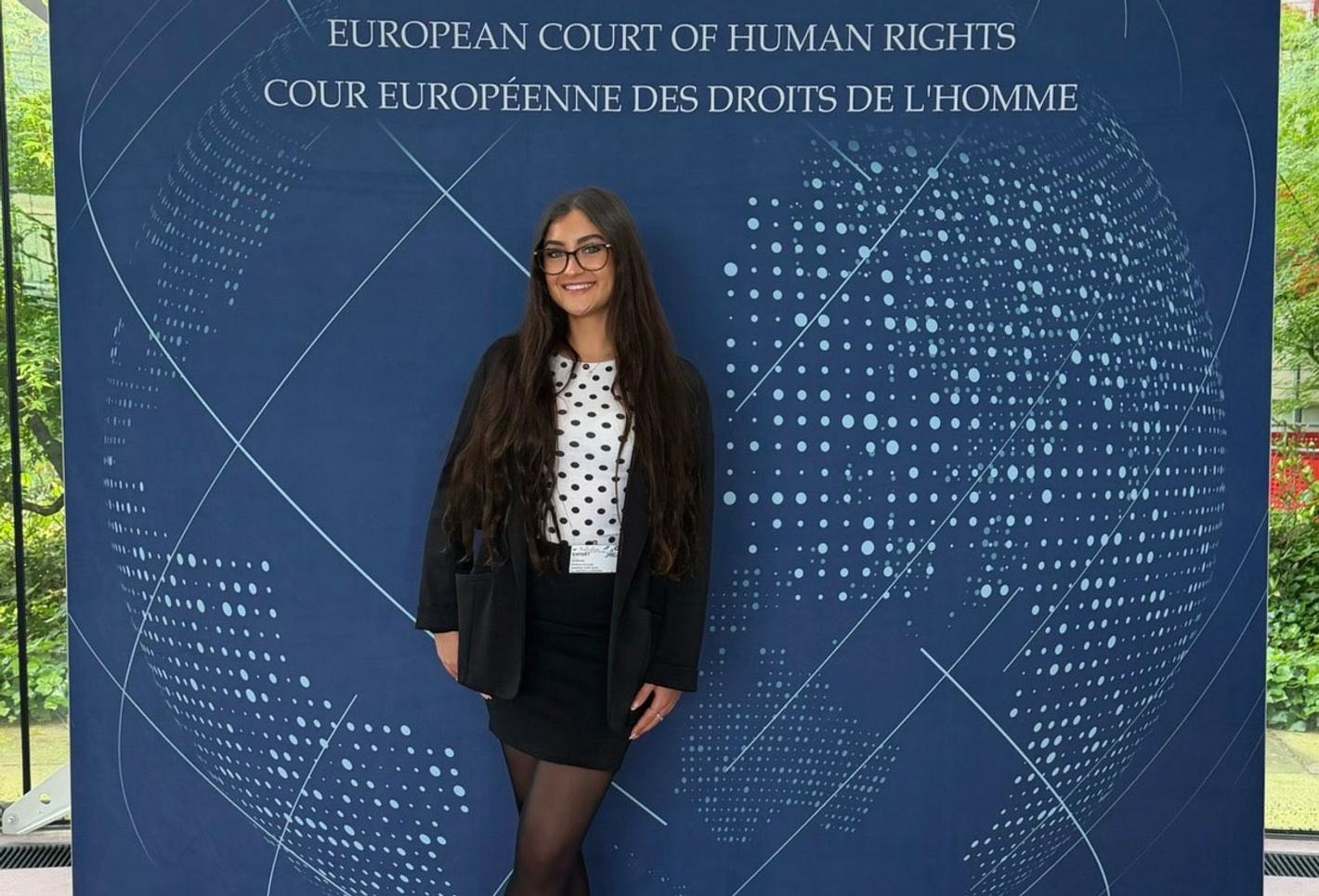
Olivia Brisson, final year LLB studentIn May 2026, I had the incredible opportunity to visit Strasbourg on a three-day university law trip and explore the institutions at the heart of European human rights protection.
Having completed the Human Rights module of my law degree just a month earlier, the timing of the trip was particularly meaningful.
The trip gave me the opportunity to see how the legal principles I had studied in the classroom operate in practice, making the experience both intellectually rewarding and personally memorable.
Meeting judges at the European Court of Human Rights
One of the highlights was visiting the European Court of Human Rights (ECtHR) and meeting Judges Vahe Grigoryan, Hugh Mercer and Kateřina Šimáčková.
Hearing directly from judges about their experiences and perspectives offered valuable insight into the realities of human rights adjudication.
During our meeting with Judge Grigoryan, we learnt about the history of the Court and how cases come before it.
He described the ECtHR as a “temple of justice on human rights matters”. This phrase captured the significance of the institution and its role in protecting fundamental rights across Europe.
It was fascinating to hear about the Court’s work from someone directly involved in it and to reflect on the responsibility that comes with deciding cases that can have a profound impact on people’s lives.
When classroom learning meets real-world law
Our meeting with Judge Mercer was particularly interesting given that, before our trip, our Human Rights class had written an essay on the living instrument doctrine.
The doctrine recognises that the European Convention on Human Rights must be interpreted in light of present-day conditions.
Hearing his perspective on a topic we had so recently studied made the discussion especially relevant. He suggested that the living instrument doctrine is more like a tree, but that “the tree should be living, not moving.”
This gave me a new way to think about the balance between allowing human rights protections to evolve with society and maintaining stability and consistency in the interpretation of the Convention.
The role of judges in human rights protection
Judge Mercer also discussed the differences between sitting alone as a High Court judge and sitting as part of the ECtHR’s different formations: a committee of three judges, a Chamber of seven and the Grand Chamber of 17.
Our meeting with Judge Šimáčková was equally insightful. She spoke about cases involving sexual assault and gender-based violence, alongside the importance of the Istanbul Convention and the need for victims to be recognised.
The discussion brought the human impact of human rights law to the forefront of my mind. While legal study often requires us to analyse judgements, legislation and legal tests, hearing about these issues in the very place they are heard highlighted the realities faced by victims and the importance of ensuring that their experiences are heard and acknowledged.
It was a powerful reminder that behind every case is a person whose dignity, safety and rights matter.
Understanding how European institutions work
Beyond the ECtHR, we visited the European Parliament, where we had the opportunity to witness a debate on agriculture. One of the things that impressed me most was the speed at which the interpretation and translation services operated.
Watching participants engage in a live debate across different languages was remarkable and gave me a greater appreciation of the complexities of international cooperation.
We also learnt about the work of the Council of Europe’s Department for Execution of Judgments. Before the visit, I had not fully appreciated the work required to ensure that judgments lead to meaningful change.
The department oversees how member states comply with ECtHR judgments and learning about this process was particularly valuable. We also gained insight into the department’s structure and the different roles involved in supervising the implementation of judgments.
This highlighted that a judgment is not the end of the process. Ensuring that states implement the required measures is vital to making human rights protections effective in practice.
Discovering Strasbourg beyond the classroom
Of course, the trip was not only about the institutions we visited. Strasbourg itself was a beautiful city to explore, with its picturesque canals, historical architecture and charming streets.
From wandering around the historic centre and along the canals to discovering many restaurants and cafés, there was plenty to enjoy outside our scheduled activities.
The atmosphere in Strasbourg was the perfect setting to an already rewarding experience which combined academic learning with the opportunity to discover somewhere new.
A different perspective on human rights law
I returned from the trip with a deeper appreciation of the institutions, people and processes that protect human rights across Europe.
Most importantly, the experience reminded me that human rights law is not simply an academic subject. It has real consequences for individuals and communities we live in.
I am incredibly grateful for the opportunity to have witnessed this work firsthand. It is an experience that will stay with me throughout my legal studies and beyond.
About the author
Olivia Brisson is a final-year LLB student in London aiming to pursue a career in law. This is her first published article, marking an exciting milestone in her legal journey.
Passionate about the principle that everyone should have the opportunity to seek justice, Olivia is particularly interested in the law of tort, medical law and human rights law.