

What we’ve learned about babies in nursery from our research
3 July 2026
/11x0:990x665/prod01/channel_3/media/middlesex-university/mdx-voices-images/BabyRooms1000X665.jpg)
Article Written By
Dr Mona Sakr, Associate Professor in Early Childhood Studies, Middlesex University; Dr Sarah Bonetti, Independent Researcher; Kayla Halls, Researcher in Early Childhood Studies, Middlesex UniversityIt's an exciting time to work in the early year sector
In September 2025, the English government completed their expansion of the funded childcare entitlement to children from nine months old. This has sparked both significant change and pressing questions across the sector.
As a research team over the last two years, we’ve scrutinized what these changes have meant for babies, families and nurseries. We’ve explored what good practice looks and feels like with babies (children aged 0-2 years old) in nursery and how to move forward to ensure that babies get the best from their experiences outside of the home. As we wrap up this two-year Nuffield Foundation-funded project, we’re sharing our biggest findings from the largest study of baby rooms in England and what needs to happen next.
When we refer to ‘the baby room’, this is a simple way of saying provision for children under two years old that takes place in a nursery.
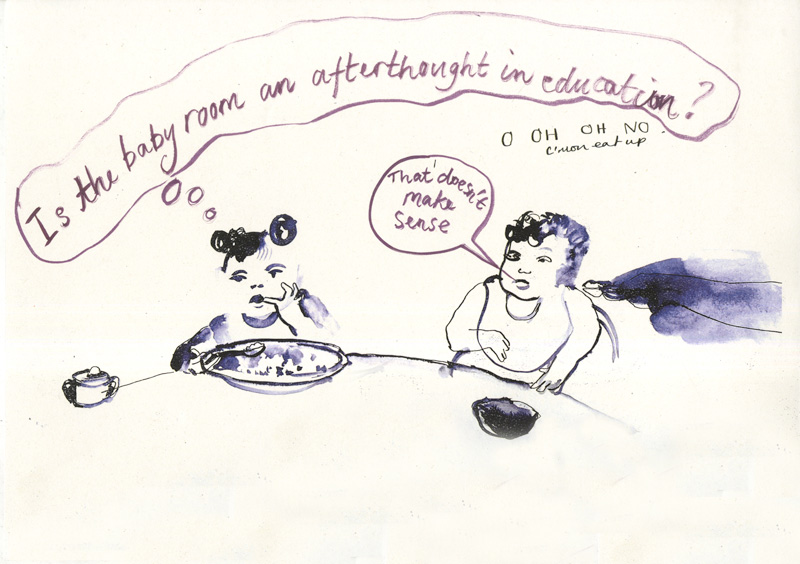
Illustration by Louise Weir, Senior Lecturer in Illustration, Middlesex University.
What good practice looks and feels in the baby room
We spoke with more than three hundred baby room educators and nursery managers across England about what good practice looks and feels like with our youngest learners. The ideas they shared crafted a clear vision of what babies need to thrive:
- High-quality baby rooms need attuned and responsive educators. Educators need time to really know each baby, building secure relationships so babies feel safe, understood and cared for. They must be skilled in noticing and responding to babies’ cues, offering warm, one-to-one interactions that support their development and wellbeing.
- High-quality baby rooms should be calm and interesting places to learn. The environment needs to be calm, predictable and emotionally safe, helping babies to settle, relax and feel secure. At the same time, it must offer vibrant sensory experiences and opportunities to explore, so babies can follow their fascinations and curiosities about the world.
- High-quality baby rooms value working closely with families. Educators need to build trusting relationships with families through open, honest communication and by sharing everyday experiences. Families should feel welcomed, supported and part of a community, with opportunities to ask questions about their child
What baby room educators need to bring this vision to life
Baby room educators cannot deliver this vision of good practice on their own. They need support from across the early years’ sector, ranging from nursery managers to central government.
One of the most urgent changes we need to make nationally is to cap group size in the baby room. Currently, while we regulate adult: baby ratios, there are no regulations around group size and a significant proportion of the baby rooms we connected with had more than 12 babies in the same room.
While the largest study of English baby rooms is ending, there is still plenty of work to be done to ensure babies get the provision they need to thrive. A robust body of evidence shows that smaller groups make it possible for educators to build strong relationships with babies, giving them the attention they need.
They also help create calmer environments where babies feel secure and interactions can be more meaningful. In our research we came across nurseries with anywhere from three to 30 babies in a room. With so many babies in one space, it can make it difficult, perhaps even impossible, to provide the calm, responsive environments that babies need to thrive.
Baby room educators also need special qualifications and training that focuses specifically on babies’ development, care and learning. Ongoing professional learning, especially hands-on coaching and networks, helps educators have time to reflect and deepen their practice whilst staying up to date on changes in the sector. Qualifications at the moment rarely focus on children aged 0-2 years old, and professional learning focused on babies can be hard to access. Indeed, only 35% of baby room educators in our study had accessed professional learning in the last 12 months.
The good news is, we have started to see shifts across the sector that support baby room educators. The Department for Education has updated their school-based nursery guidance to encourage schools to have no more than 12 babies in a room. We have also seen an increase in the professional learning available for baby room educators, ranging from baby room networks to webinars. At Middlesex University, we’re leading the shift towards more baby-specific professional; we’ve revised our degree in BA Early Childhood Studies to learn from this research and ensure its relevance to practice with 0–2-year-olds.
What needs to happen next for the baby room
Although the largest study of English baby rooms is ending, there is still plenty of work to be done to ensure babies get the provision they need to thrive
We have several recommendations across the project ranging from regulating group size to improving professional learning. But beyond these practical changes, our research also raises a bigger question about the purpose of the baby room.
While the early years sector has a clear vision of what good practice looks like, we are missing a statement articulating the purpose of the baby room. Having a purpose for the baby room means spelling out what baby room provision is meant to deliver and why, along with who it serves and how it serves them. We might want to centre the purpose around supporting babies’ well-being, championing their development, getting parents back to work, or a combination of these and other focuses. We are calling on the Department for Education (DfE) to step in and offer a clear statement of purpose for the baby room, embedded in the Early Years Foundation Stage (EYFS), as a fundamental step in creating a strong foundation for baby room provision going forward.
To learn more about the research, please visit The Baby Room Blog.
Find out about our Early Childhood Studies BA Honours degree.