

Why art matters
5 May 2026
/0x63:1200x878/prod01/channel_3/media/middlesex-university/mdx-voices-images/John-Timberlake-Granary-Gallery-Berwick1200X941.jpg)
/filters:format(webp)/0x0:350x350/prod01/channel_3/media/middlesex-university/about-us-images/nQwbeZbuMItH96kg.jpeg)
Article Written By
Professor Kurt Barling PhD MSc BA FRSA SFHEA - Deputy Dean, Research & Knowledge Exchange; Faculty of Arts & Creative IndustriesLoss and landscape
The current Berwick solo exhibition by Dr John Timberlake begins in grief, but it does not remain there. It starts with the loss of a father and with the quiet, persistent need to find a way back to what cannot be recovered except through memory. Berwick becomes the place where that return is possible. Its coastline, weather, rock, and shifting light hold the trace of childhood visits and of a relationship once lived in ordinary time. To go back to this landscape is not simply to revisit a view. It is to enter a terrain where remembrance can take form.
A lifetime vs. geological time
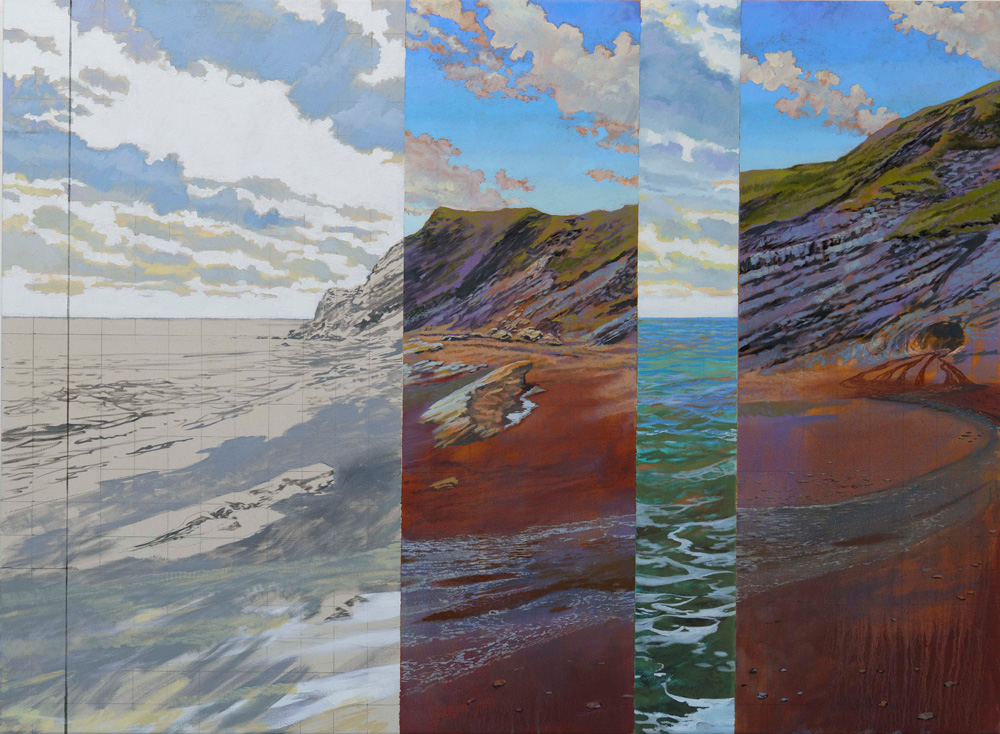
What emerges through the work is a profound tension between human time and geological time. In the aftermath of personal loss, a lifetime can feel at once immeasurably large and heartbreakingly brief. The artist’s research into the environmental and geological history of the Berwick landscape deepened this awareness. Through conversations with geologists and environmentalists, the land was understood not only as scenery or backdrop, but as a record of immense duration, shaped over millions of years by pressure, fracture, erosion, sediment, and change. Against this vast temporal scale, human life appears fragile and fleeting. Yet it is precisely this contrast that gives the work its emotional force.
Our place in the landscape
The paintings hold these two scales of time together. They are acts of mourning and acts of attention. They ask how personal memory might be carried by a landscape that long predates us and will long outlast us. In this sense, the land becomes more than a site of recollection. It becomes a witness. Its cliffs, strata, and horizons suggest that loss is both intimate and universal, part of the small drama of a single life and part of a larger continuum of formation, disappearance, and return.
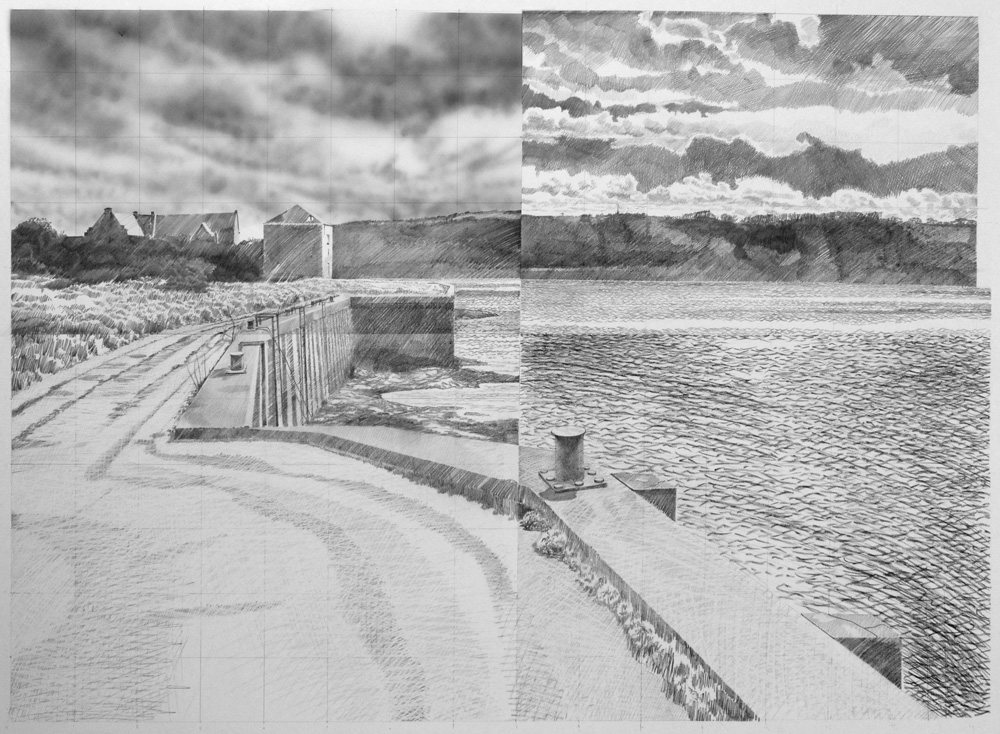
Timberlake's work therefore moves beyond elegy in any narrow sense. It is not only about absence, but about duration. Not only about the pain of losing someone deeply loved, but about the enduring need to place that loss within a world that is itself marked by deep time. Memory here is not static or sentimental. It is active, searching, and embodied. It is made through walking, drawing, looking, and returning. The resulting works reflect an artist trying to understand how place can hold feeling, how landscape can become a vessel for remembrance, and how art might mediate between the scale of a human life and the vastness of environmental time.
Remembrance and continuity
In these paintings, landscape is never merely descriptive. It is emotional, temporal, and philosophical. And rather beautiful. Berwick is both a real place and a field of reflection, where childhood memory, paternal loss, and geological immensities meet. The works invite us to consider how lives are marked into places, and how those places, in turn, remind us that all human experience unfolds within timescales far greater than our own. What they offer is a moving meditation on love, loss, and continuity: on the desire to remember someone fully, even as one confronts the humbling fact that a lifetime is only a brief moment in the long history of our fragile planet.
Dr John Timberlake's exhibition, 'Berwick Sequence', is at the Granary Gallery, Berwick-Upon-Tweed until Wednesday 20 May 2026.
Find out more about the Faculty of Arts and Creative Industries at Middlesex University.