

Language and Communication Research Group
About us
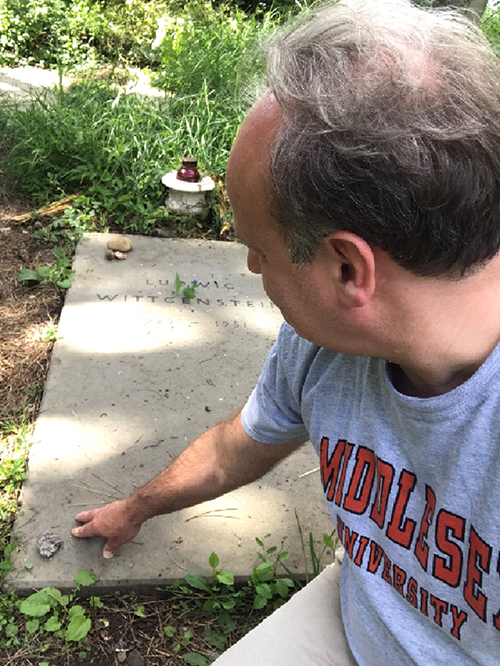
The Language and Communication Research Group is an enthusiastic, interdisciplinary community of scholars and researchers from across Middlesex University. We study all aspects of language and communication, and their place in our lives.
Our research interests include:
- Philosophy of language
- Theory of communication
- Language in the media
- Semantics and pragmatics
- Language as a human phenomenon
- Gender and age in language use
- Language and place
- Political communication
- Dialogue, narrative, and storytelling
- Language in critical theory
- Semiotics and rhetoric.
The group has a long history at Middlesex University. It builds on the ground-breaking work in biosemiotics and cultural studies conducted by Paul Cobley, now Emeritus Professor, and his colleagues. Linguists such as Billy Clarke have also contributed to this work.
We have made significant contributions to narrative theory, close reading, and its practice. Research into language and communication at Middlesex reflects the University’s culture of theoretically grounded, critical, engaged, and socially impactful scholarship.
This culture has created a research environment that takes a broad approach to language. We examine language as more than a code-based domain. We are interested in language as a material and embodied practice. We explore how it forms an organic part of social, cultural, natural, interpersonal, and intrapersonal processes.
We see the study of language and linguistic diversity as central to social transformation. It is also a valuable field of study in its own right. Through our research, we aim to improve social understanding of language, communication, and their role in human wellbeing.
We also support the development of communicative competence in all Middlesex students. We recognise it as one of the most important graduate attributes. A contemporary, critical, and inclusive concept of eloquence guides our contribution to teaching and learning at the University.
Our approaches
The group’s long-standing traditions of thought and practice continue through:
- Discourse Analysis
- Conversation Analysis
- Multimodality
- Systemic Functional Linguistics
- Integrationism
- Critical Discourse Analysis
- Rhetorical Theory
- Modelling Systems Theory
- Dialogue Studies
- Philosophy of Communication
- Other approaches to the study of language and communication.
Recent research and publications
Group members have recently researched and published on:
- Prosody
- Parliamentary discourse
- The language of religion and utopia
- Narrative
- Discourses about food and ageing
- Language in environmental humanities
- Translingualism
- Dialogue
- Rhetorical conversation analysis
- Rhetorical approaches to syntax
- Philosophy of communication
Metacognitive approaches to reading pedagogies
Freedom of speech.
The group is home to the European Journal for the Philosophy of Communication (Empedocles). It is also a co-home of the journal Social Semiotics and the Handbooks of Communication Science book series.
We are closely involved in the Section for the Philosophy of Communication of the European Communication Research and Education Association (ECREA).
Group members serve on editorial boards and have published in journals such as Language and Communication, Language Sciences, Discourse Studies, and Futures.
PhD supervision
We welcome PhD projects in any of our areas of interest and expertise. Contact members of the group to discuss your proposal.
Dr Alessandra De Tommaso
Senior Lecturer in Law
Dr Vlad Morariu
REF Manager
Prof Johan Siebers
Professor of Philosophy of Language and Communication
Prof Anastasia Christou
Professor of Sociology and Social Justice
Associate members
- Dr Sinead Kwok, Hong Kong University - View profile
- Dr Adrian Pable, University of Applied Sciences and Arts of Southern Switzerland - View profile
Calls for papers
We publish calls for papers from our research group and collaborators:
Events
On 8 October 2025, we held an event that explored how plant memory can inform principles of digital ecologies. The event also discussed Valentina Vetturi's research project.
Language and Communication research seminars
The Language and Communication Research Group hosts regular seminars on language, discourse, and communication. The programme also considers literature, creative writing, and film. This breadth reflects our inclusive view of the subject area.
Sessions include research presentations, workshops, and reading groups.
In previous years, we have explored:
- Monsters in Popular Cultural Texts, from witches and vampires to zombies and werewolves
- National and sexual identities
- Interpretation and reformation
- Multimodality and supercategory semantics
- Naming practices
- Archival research
- The Gothic
- Reading on screen
- Visual semiotics and site-specific drama
- Creative criticism
- Languaging
- Language innovation and change
- Accents in film and television
- Intertextuality and reimagining Orwell
- City poetry
- American metafiction
- Narrative
- Fictionalising transatlantic slavery
- Philosophies of dialogue
The sessions are free and open to all staff, students and guests. For more information or if you would like to lead a session, please contact us.
Collaborations
The Language and Communication Research Group collaborates with:
- Institute of Languages, Cultures and Societies, School of Advanced Study, University of London
- Department of English, Manchester Metropolitan University
- Department of English, Hong Kong University
- Institute of Science and Environment, University of Cumbria
- Other partner organisations
Workshops and projects
- The concept of language in the 21st century
- Violence and Unhappy Endings: Book Presentation 4 December 2025, 16:00-18:00 (PDF)
- ECREA Philosophy of Communication Workshop, “Dialogue as Community Building and as Philosophical Method” (PDF)
- Middlesex Roundtable on Signs, Language and Communication
- Consuming Authenticities
- The Grenglish Community Engagement Project
- Ernst Bloch Centre for German Thought: Buber Seminar Series
- Political Communication: gender and linguistic participation in parliaments; political interviews
- Pre-school narratives: psychological causality in contemporary media for children
- Communicating Wisdom: A Study of Fishing in Youth Work
- Ontological Generosity: The Communicability of Being.
- Voices of the Future
- Digital Voices of the Future